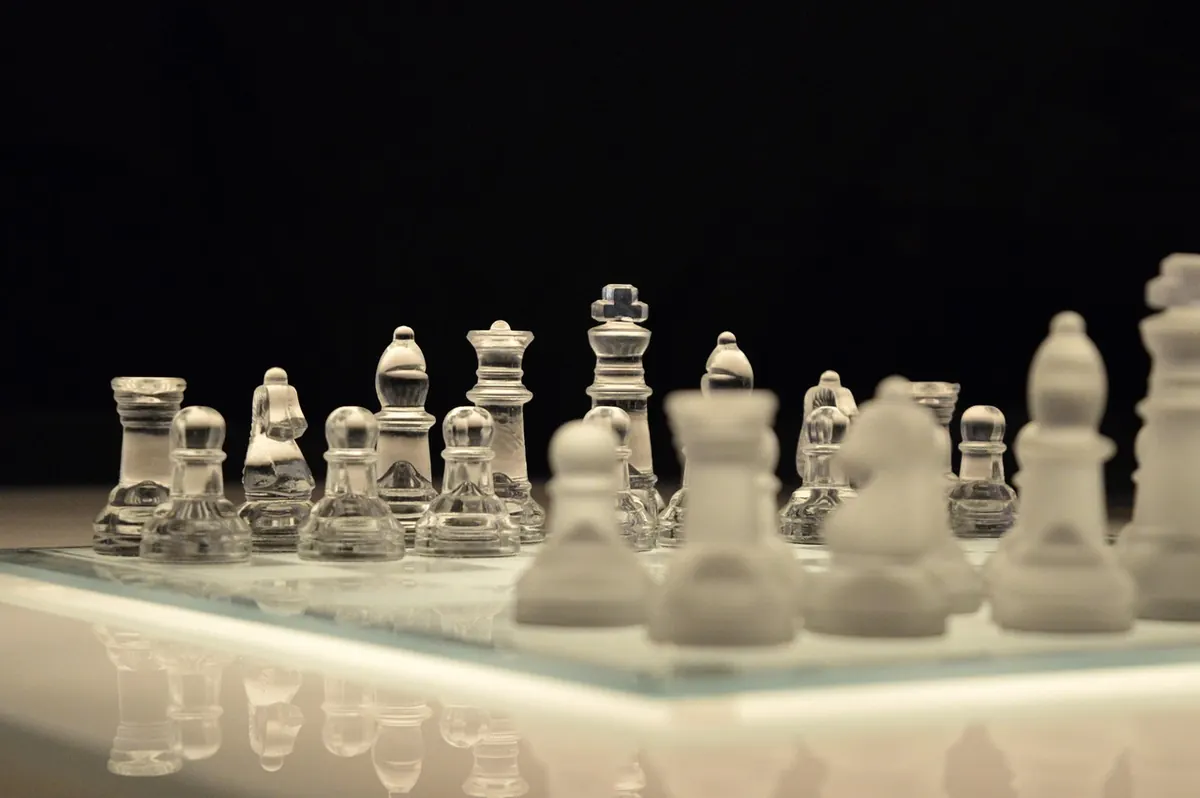
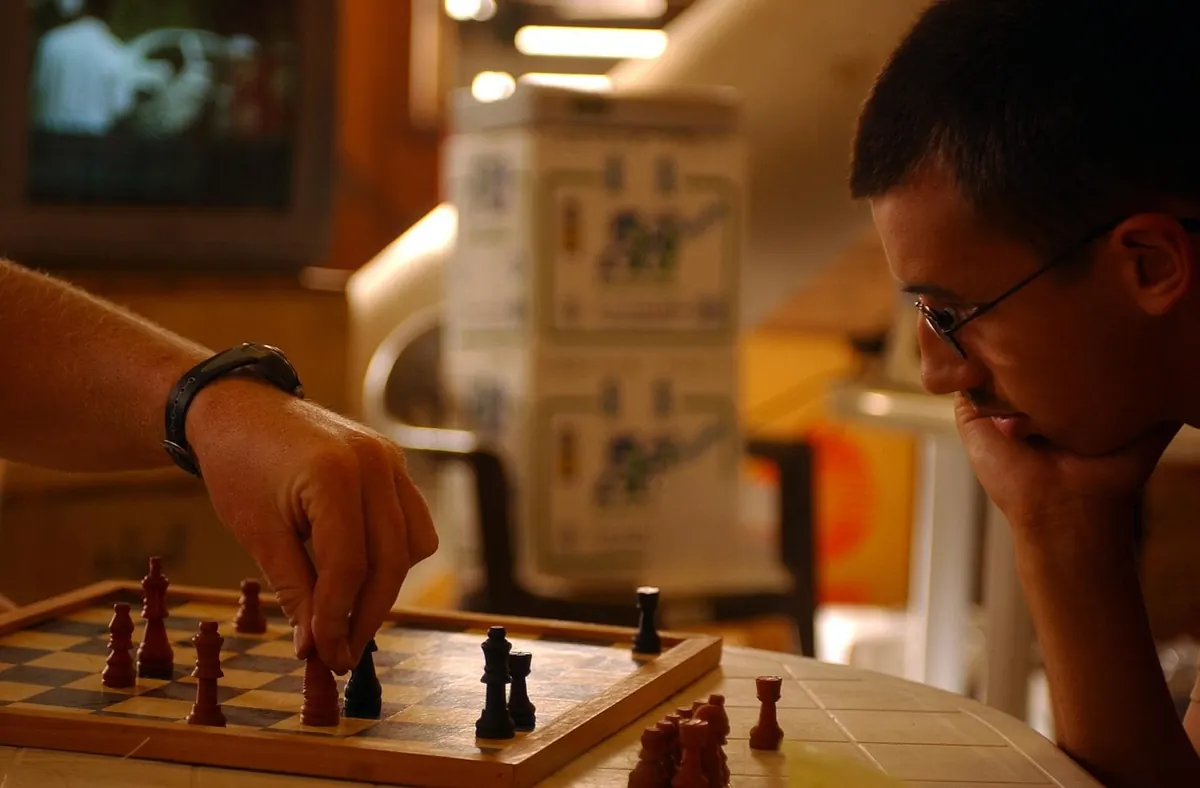
Mate in one is the simplest checkmate to spot, but it still trips up new players. The trick is not deep calculation. It is pattern recognition. Once you have seen a back-rank mate a hundred times, it jumps out at you. The twenty puzzles below are all White to play and mate in one. Set them up on a board, or solve them in your head. Each one teaches a pattern you will meet again and again.
How to Find a Mate in One
Every mate in one begins with a check. You cannot checkmate without giving check, so start by listing every check you can give. Then test each one against three questions.
- Can the king move to a safe square?
- Can any black piece capture the checking piece?
- Can any black piece block the check?
If the answer to all three is no, you have found mate. That is the whole method. The difficulty is not the logic; it is spotting the candidate moves quickly. Look for pieces that already aim at the enemy king. A rook on the same file or rank, a bishop on a diagonal, a knight within jumping distance. Also look at the king's escape squares, and count them before you move rather than after. If the king has two flights, ask whether a single move can cover both. Usually that means a queen move, a knight move, or a check delivered by a piece that is itself protected.
One more habit worth building: rank your candidate checks by how forcing they are. A check that captures a defender or pins a piece is almost always stronger than a quiet one. In a mate-in-one puzzle, though, every candidate deserves a full test, because the position guarantees that an answer exists somewhere.
The Twenty Puzzles
Each puzzle below is White to play. The pattern name comes first; the idea comes second. Try to see the mate before you read the explanation, then check whether your reasoning matches.
Family 1: Back-Rank Mates (Puzzles 1–4)
The king sits behind its own pawns and the eighth rank is the road in. Any rook or queen that reaches that rank with support delivers mate, because pawns cannot move backwards and the king has no escape.
- Puzzle 1 — Rook lift. Black king on g8 with pawns on f7, g7 and h7. White's rook slides from a1 to a8. The pawn wall blocks the king's escape and nothing can interpose on a rank.
- Puzzle 2 — Queen on the eighth. Same pawn shield, but the rooks have been traded. White's queen steps to e8, protected by a bishop on b5, while Black's heavy pieces are stuck on the far side of the board.
- Puzzle 3 — Deflection first. Black's rook guards the eighth rank but is also pinned by a bishop. Capture the guard, or drive it away, and the entry square becomes mate.
- Puzzle 4 — Long-castle back rank. Black has castled queenside and the pawn wall on that wing is intact. White's rook swings to c8 or d8 while the king is boxed in on b8.
Family 2: Smothered Mates (Puzzles 5–8)
Here the king is buried under its own pieces and a knight delivers the blow. The classic finish puts a knight on f7 or g7, checking the king while every escape square is occupied by a friendly piece.
- Puzzle 5 — Knight to f7. King on h8, rook on g8, pawns on g7 and h7. The knight hops to f7. The king cannot take because the knight is defended, and every square around it is blocked.
- Puzzle 6 — Queen sacrifice, knight finish. A queen check forces the black rook to g8, then the knight lands on f7 for mate. The sacrifice is not decoration; it is the mechanism.
- Puzzle 7 — Knight on g7. A mirror image of the classic. The knight checks from g7 while h7, h8 and the rook on f8 block everything else.
- Puzzle 8 — Two-knight smother. Two knights and a queen cooperate, and the final check comes from a knight that is attacked but untouchable, because capturing it would open a line onto the king.
Family 3: Queen and Bishop Diagonal Mates (Puzzles 9–12)
This is the "kiss of death" family. The queen lands next to the king on a diagonal, supported by a bishop. The king cannot capture because the queen is defended, and it cannot run because the bishop covers the flight squares.
- Puzzle 9 — Queen to h7. King on g8 with pawns on f7 and g7. The queen takes on h7, guarded by a bishop on d3.
- Puzzle 10 — Queen to g7. The queen arrives with bishop support along the long diagonal, and the rook covers the eighth rank so the king cannot slip away sideways.
- Puzzle 11 — Greek gift finish. The bishop has already landed on h7, and the queen follows to g7 or h7 for the final blow. This is the mating idea behind a whole family of sacrifices.
- Puzzle 12 — Two-bishop cross. Bishops slice two diagonals and a queen check on the kingside clinches it, with no square left for the king.
Family 4: Rook and Knight Combinations (Puzzles 13–16)
These mates look chaotic but follow a simple division of labour: the rook cuts off a rank or file, and the knight covers whatever square remains.
- Puzzle 13 — Rook checks, knight seals. The knight on e7 controls the flights while the rook checks along the eighth rank.
- Puzzle 14 — Knight checks, rook covers. The knight on g6 gives check while the rook controls the last escape square. Remove either piece and the mate disappears.
- Puzzle 15 — Arabian mate. Rook and knight side by side in the corner. The rook checks, the knight defends the rook and guards the corner square.
- Puzzle 16 — Anastasia's mate. The knight on e7 controls g8 and g6 while the rook checks down the h-file. The king is trapped between its own pawn and the edge.
Family 5: Pawn and Discovered Mates (Puzzles 17–20)
Sometimes the smallest piece lands the blow. A pawn push can take away the last flight square, or deliver mate itself when the king is already trapped against the edge.
- Puzzle 17 — Pawn to g7 mate. A supported pawn advance to the seventh rank checks the king, which cannot escape to the eighth because its own pieces block the way.
- Puzzle 18 — Discovered check. Move a piece out of the way and the piece behind it delivers mate, because the king has no answer to the newly opened line.
- Puzzle 19 — Double check. Two pieces check at once. Nothing can block both lines, so the only hope is a king move, and every square is covered.
- Puzzle 20 — Pawn capture mate. A pawn captures a defender on h7 or g7, opening a file for the heavy piece behind it. The mate arrives by capture, not by a quiet move.
Why These Patterns Repeat
Chess openings are varied, but the mating nets are not. The same finishes appear in the Sicilian, the Italian, the King's Indian and the Caro-Kann, because the king always castles to one of two squares and the pawn structure in front of it is usually the same shape. Learn a back-rank mate once and you will spot it in a hundred different games.
The player who knows the pattern does not calculate the mate. They recognise it, and then they verify it.
Recognition is faster than calculation, and in blitz it is the only thing that works. In a long game, recognition tells you where to calculate in the first place. That is the real value of drilling simple mates: you are not memorising twenty positions, you are building twenty reflexes.
Common Mistakes That Cost You the Mate
- Checking with the wrong piece first. Two checks look similar, but one leaves the king a flight square. Test each candidate completely before committing.
- Ignoring the defender's capture. The most frequent error is missing that a knight or bishop can simply take the checking piece.
- Forgetting the block. Queens, rooks and bishops can be interposed. A check on a rank or file is only mate if the line truly cannot be closed.
- Assuming the king must move. Beginners look only at king flights and forget that capture and block are legal answers too.
- Rushing the final move. One-move mates are the easiest place to blunder. Count the escape squares one last time before you play it.
How to Practise So the Patterns Stick
Twenty puzzles are a start, not a training programme. Use them the way a musician uses scales.
- Solve the set once slowly with a board, and say the pattern name out loud each time you find a mate.
- Repeat the set two days later from memory. Speed is the goal on the second pass.
- Then take the patterns into your real games. After each game, ask whether a back-rank or diagonal mate was available and you missed it.
- Build your own set. Take twenty positions from your own games and label each one by pattern.
Do that for a month and mate in one stops being a puzzle. It becomes something you simply see, which is exactly the point.
Photo: jarmoluk / Pixabay